



Bad Bushing Symptoms: 7 Signs You Shouldn't Ignore
Bad Bushing Symptoms: 7 Signs You Shouldn't Ignore
Quick answer: The main bad bushing symptoms are clunking noise over bumps, vibration in the steering wheel, uneven tire wear, and play in the control arms. Rubber bushings wear out after 50,000-80,000 km, while polyurethane bushings last 3-5 times longer. Don't put off diagnosing the first symptoms.
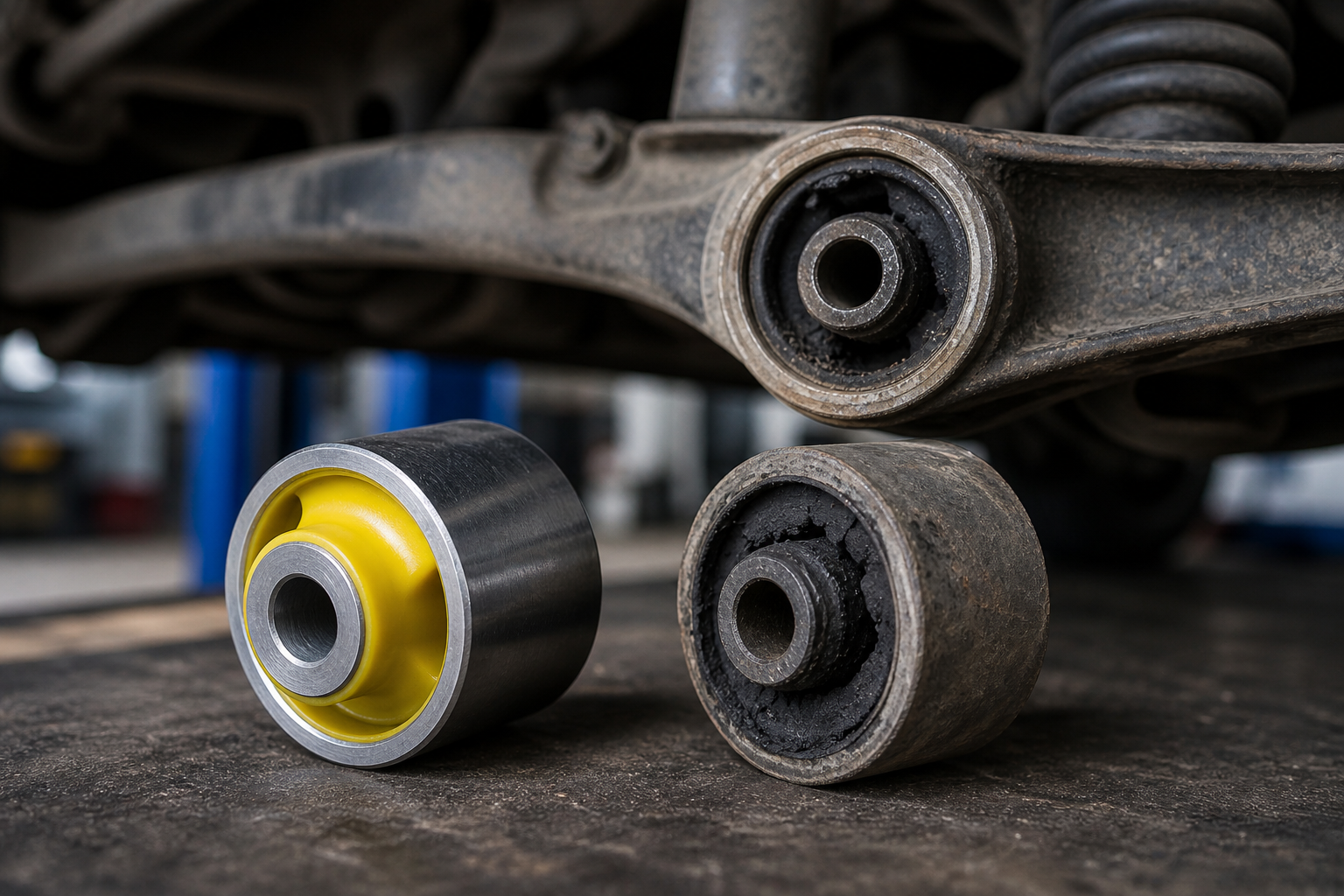
What Is a Worn Bushing?
A bushing is a rubber-and-metal suspension joint that provides a flexible connection between the control arm and the car body and dampens impacts and vibrations from the road. A worn bushing is a part whose rubber insert has lost its elasticity, become deformed, or delaminated, and no longer does its job.
A damaged joint doesn't isolate vibration - it passes it straight to the body. For more on how bushings are built and how they work, see: What Is a Car Bushing and Why Do You Need It.
7 Bad Bushing Symptoms to Watch For
Bushings in a car wear out gradually - the symptoms build up and are easy to miss at first. Here's what to watch for.
1. Clunking Noise Over Bumps
A distinct "clunk" or dull knock when crossing speed bumps, pulling out of a pothole, or turning - this is the most common sign of wear. The noise happens because a broken-down bushing insert allows direct metal-on-metal contact in the control arm mount.
A single clunk doesn't always point to bushings specifically - it could be a strut mount or a ball joint. But a recurring knock tied to road bumps is the first suspicion of worn suspension components.
2. Vibration in the Steering Wheel and Floor
A fine vibration at 60-100 km/h (37-62 mph) that comes through the steering column or the floor is a sign of worn subframe or front control arm bushings. A worn joint doesn't absorb vibration from the wheels, so it travels straight into the body, cutting into ride comfort. Steering wheel vibration can have other causes too (wheel balance, alignment) - if it shows up together with other symptoms on this list, worn bushings are a likely culprit.
3. The Car Pulls to One Side When Braking
If the car drifts to one side under braking on its own, worn control arm bushings have changed the suspension geometry. The wheel is no longer sitting at the correct angle - it deflects and pulls the car sideways. This is both a sign of a fault and a direct threat to road stability.
4. Uneven Tire Wear
A worn joint throws off the wheel alignment - the camber and toe angles. If the inner or outer edge of the tread is wearing faster than the rest, check not just the alignment but also the condition of your suspension bushings. The problem will come back after an alignment if you don't fix the root cause - worn parts.
Worn bushings can cause uneven tire wear again within just a few thousand kilometers of an alignment. Timely replacement is the only real fix.
5. Play in the Suspension
Lift the car and rock the wheel in a vertical plane - noticeable movement points to play in the joints. This test lets you check bushings yourself, without a lift. Play in the horizontal plane is more typical of a ball joint; in the vertical plane, it points to control arm bushings.
6. "Floaty" Handling
The car responds to steering input late, its line through corners becomes unpredictable, and the wheel starts to feel "numb" - all of this affects driver comfort and safety. Worn suspension parts, especially subframe bushings, take away steering precision, which is especially noticeable at speed.
7. Visible Damage on Inspection
The simplest way to check is to lift the car and look at the parts directly. Cracks in the rubber insert, delamination, a deformed "mushroom" squeezed out of its housing, grease leaking out of a polyurethane bushing - these are signs of wear you can see without any tools. If the insert has been pushed out past the mount, replacement is urgent - ignoring this state speeds up wear on the neighboring components.
How to Check Bushings Yourself
There are two ways to assess the condition of your bushings without a trip to the shop.
Visual inspection. Drive onto an inspection pit or lift the car. Check the bushings from every side: look for cracks, deformed rubber, and play in the metal sleeves. Pry the control arm with a pry bar - if there's movement, the joint is worn. It's worth checking the sway bar bushings nearby too - they tend to wear out at the same time.
Dynamic test. At 40-60 km/h (25-37 mph), turn the steering wheel sharply left and right. A knock or crunch in response is a sign of suspension trouble. Also pay attention to how the car rides on rough pavement: if every bump comes through as a clunk, it's time for a suspension inspection.
It's a good idea to check the condition of your bushings at every scheduled service - regardless of whether you've noticed any symptoms.
Also check out our channel: Bushings Installed the Wrong Way!
When to Replace: Timeframes and Mileage Guidelines
Rubber bushings are usually replaced every 50,000-80,000 km, but the real service life of these parts depends on a number of factors: driving conditions, driving style, temperature swings, and how aggressive the road chemicals are.
PolyPro polyurethane bushings last 150,000-250,000 km - 3-5 times longer than rubber. The service life of polyurethane bushings doesn't shrink from frost (-40°C / -40°F), road chemicals, or oils. The warranty is 12 months with no mileage limit.
Regardless of mileage: if you're seeing symptoms from this list, don't wait for a "scheduled" service. Catching damaged bushings early lets you avoid expensive repairs to neighboring parts - ball joints, control arms, guide components. It's much easier to extend the life of your suspension as a whole if you catch the problem early.
It's obvious that it's time to replace them once the symptoms show up. But there's a mileage benchmark too: if your car has covered 80,000 km on its original rubber parts, it's worth checking their condition even without any signs of wear.
After replacement, be sure to get a wheel alignment done - worn parts had changed the suspension geometry, and new bushings won't restore the angles on their own.
For a detailed look at the replacement process: How to Replace Control Arm Bushings, Step by Step.
Also see: How Long Original Bushings Last - to get a sense of real-world lifespans and wear signs under different conditions.
Where to Buy and What to Look For
PolyPro polyurethane bushings are available for most makes and models - from passenger cars to agricultural machinery. Prices start at 80 UAH per piece, and having front bushings replaced at a shop starts at 400 UAH for labor.
If you can't find your part, call us: (050) 21-35-163, (067) 21-35-163, or message us on Viber.
Отримати консультацію по підбору деталей:
Получить консультацию по подбору деталей:
Get a consultation on choosing the right parts:
VIBER

TELEGRAM