



What Is a Car Bushing: Design, How It Works, and When to Replace It
Quick answer: A bushing (silent block) is a rubber-metal or polyurethane-metal joint that connects moving suspension parts to each other and to the car body. Its job is to dampen vibration, impacts, and noise while driving. It typically lasts 50,000–100,000 km (roughly 31,000–62,000 miles), depending on the material and driving conditions.
A bushing is probably the most unnoticed part of your car — until the day it starts reminding you of itself on every pothole.
What Is a Car Bushing and What Is It Made Of?
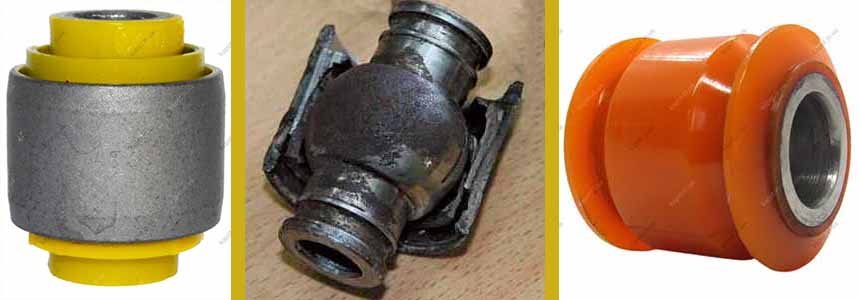
A bushing is a flexible joint made of two metal sleeves — an inner sleeve and an outer sleeve — with an elastic rubber or polyurethane element pressed in between them. That's the core design of the part: three layers, each with its own role.
The inner metal sleeve is bolted to the suspension arm or the car body. The outer sleeve is pressed into the part's mounting eye. Between them sits the elastic insert, which does the actual work of absorbing vibration and impact loads. The whole assembly comes down to two metal sleeves and a layer of flexible material — and that combination is what gives the bushing its unique properties.
Unlike a ball joint, which relies on metal surfaces sliding against each other, a bushing has no metal-on-metal contact at all. Movement comes from the elastic layer flexing — no play, no friction, no metal-on-metal wear. That's exactly where the part gets its name: silent block, or a "quiet block."
Standard Design and Its Variants
Some bushings don't have an outer sleeve at all — instead, the part is pressed directly into the arm's mounting eye. This is more common on aluminum arms or in assemblies where the sleeve is already built into the housing. In floating bushings, the inner element has some freedom to shift along its axis — a design used in subframes and complex multi-link suspension setups.
How Does a Car Bushing Work?
While driving, a car's suspension is loaded from three directions at once: vertical impacts from bumps, longitudinal forces under braking and acceleration, and lateral loads in corners. A bushing is designed to let suspension parts move within set limits while absorbing these loads through the elastic deformation of its flexible layer.
When a wheel hits a pothole, the suspension arm shifts, and the rubber or polyurethane insert inside the joint compresses and stretches — absorbing the impact energy. Only a soft nudge reaches the car body. The smooth ride you feel inside the cabin is your suspension doing its job correctly.
When impacts start feeling sharp and the suspension begins to clunk, the bushing has done its job and is asking to be replaced.
Where Are Car Bushings Used?
This suspension part is used far more widely than it might seem. Bushings show up practically everywhere there's a moving connection between chassis components.
Front and Rear Suspension (Control Arm Bushings)
Most bushings sit in the suspension's control arms. A typical passenger car has 4 to 8 control arm bushings on the front suspension alone, split between the upper and lower arms. The rear has even more: in multi-link setups, each wheel can have 3–5 arm mounting points, each with its own bushing.
Sway Bar (Anti-Roll Bar)
The sway bar connects to the body through rubber or polyurethane sway bar bushings, and to the struts through sway bar end links. All of these connection points need flexible joints — otherwise body roll in corners and vibration would be far more noticeable. For more on this part, see our guide on what a sway bar bushing is.
Engine and Transmission Mounts
Engine mounts are essentially the same kind of bushing, just larger. They isolate vibration from the engine and transmission so it doesn't reach the car body. Without them, your cabin would feel like a tractor's. That's why, once engine mounts wear out, you feel every bit of engine vibration through the steering wheel and pedals.
Steering and Shock Absorber Mounts
Steering tie rods and shock absorber mounts also rely on flexible joints and bushings. When these wear out, the first symptom is usually a "floaty" steering feel, vague handling, and a longer braking distance.
Types of Car Bushings
By design, bushings fall into three main types. Which one gets used isn't a manufacturer's whim — it's the result of load calculations for that specific assembly.
With an Outer Sleeve
The most common design: an inner metal sleeve, a polyurethane or rubber insert, and an outer metal sleeve. The outer sleeve is pressed into the arm's mounting eye. It offers high rigidity and stability, which is why it's used in most passenger car suspension components.
Without an Outer Sleeve
This version, without a metal outer sleeve, is pressed directly into the assembly housing. It offers more flexibility and adapts better to changing suspension loads. It's common on certain models with aluminum control arms.
Floating Bushings
A specialized design where the inner element "floats" within a set axial range. It's used where the suspension needs to compensate for linear movement, not just angular movement — for example, in rear subframes or certain suspension layouts on modern cars.
Bushing Materials: Rubber vs. Polyurethane
The choice of material directly affects both how long a bushing lasts and how the car behaves on the road.
Rubber is the classic option. A rubber insert absorbs impacts well, dampens noise, and delivers a smooth ride. But rubber doesn't hold up well to environmental exposure — oil, road chemicals, UV light, and temperature swings all take a toll. Original rubber parts typically last around 50,000 km in city driving, and often less on rough roads.
Polyurethane is a different level of durability entirely. Polyurethane bushings last 3–5 times longer than rubber equivalents, resist oils, acids, and road chemicals, and hold up reliably from −40°C to +70°C (−40°F to 158°F). Real-world mileage runs up to 100,000 km or more. Polyurethane is also slightly stiffer than rubber, which improves handling and driving safety — the car responds more precisely to steering input in corners.
For a detailed comparison of both materials, see our article Polyurethane vs Rubber Bushings: Which Is Better for Your Car?
Signs of Worn Bushings
Worn bushings rarely stay silent. Your car's suspension gives clear warning signs long before things get critical.
Clunks and clicks from the suspension over bumps or when pulling away — the most common warning sign. Squeaking during slow maneuvers, especially in parking lots — a typical sign of a dry, worn-out joint. A harsh, beat-up feel, where impacts from potholes turn sharp instead of cushioned — the rubber or polyurethane inside has stopped flexing. Reduced handling and a sense that the car "floats" — the bushings can no longer hold the suspension geometry. Uneven tire wear — a direct result of wheel alignment drifting because of worn suspension joints.
On visual inspection, cracks, tears, or elastic material squeezed out past the sleeve edges are a clear sign the part is at the end of its life. You can also check on a lift: if rocking the arm by hand reveals noticeable play at the mounting points, it's time to replace it.
For the full list of symptoms, see our guide, 7 Signs of Worn Bushings.
When and How to Replace Car Bushings
It's a good idea to check bushing condition every 50,000 km. On real-world roads, rubber parts often wear out at half their rated lifespan — the roads themselves tend to remind you it's time for a replacement. Some reminders are more persistent than others.
Replace them in pairs. If one bushing on an axle is worn, the other one is close behind. Replacing just one while its pair is already tired means paying for labor and parts twice.
Torque the bolt under load. A bushing's mounting bolt should be torqued with the car sitting on its wheels under normal load — not while it's up on a lift. Tightening it "in the air" leaves the part permanently twisted, which shortens its service life significantly.
A wheel alignment is mandatory afterward. Replacing control arm bushings changes suspension geometry, so wheel alignment needs to be restored. Skip this step and tires wear unevenly while handling suffers. Read more in our article on wheel alignment after bushing replacement.
Also check out our channel: Common Bushing Installation Mistakes.
For a step-by-step replacement guide with tools and tips, see our article How to Replace Bushings.
How Much Do PolyPro Bushings Cost and Where to Buy Them
PolyPro polyurethane bushings are made for specific car makes and models. You can find the right part by make, model, and year in our bushing catalog on kapot.in.ua.
Prices start at 350 UAH per piece. Warranty — 12 months with no mileage limit. Worldwide shipping.
For help choosing a part or checking availability, call (050) 21-35-163 or (067) 21-35-163, or message us on Viber.
Get a Consultation on Choosing the Right Parts:
VIBER

TELEGRAM

This article's content may be used under the Creative Commons Attribution-ShareAlike license.
