


How to Replace Sway Bar Bushings Yourself
Quick answer: Replacing sway bar bushings is one of the simplest suspension jobs you can do yourself. You'll need a jack, a 12–13 mm wrench, and 30–60 minutes. The main signs of worn bushings are knocking and squeaking in turns, vibration over bumps, and reduced handling precision. PolyPro polyurethane bushings last 3–5 times longer than rubber ones.
Sway Bar Bushing Basics: A Quick Recap
A sway bar bushing is a flexible suspension part that secures the sway bar to the car's body through a steel mounting bracket.
The sway bar connects the left and right wheels and limits body roll in corners. The bushings are what absorb and dampen the vibration coming from the bar as you drive. Don't confuse them with sway bar links — those are separate parts that connect the bar to the suspension control arm. For a full breakdown of the design and function, see What Is a Sway Bar Bushing?
How to Tell Your Sway Bar Bushings Need Replacing
Worn suspension parts give off clear symptoms that are hard to mistake for anything else.
Knocking and Squeaking While Driving
A distinct knock or squeak when you turn the steering wheel is the most common sign of worn sway bar bushings. The noise happens because the worn part no longer isolates the bar from the metal bracket, so metal ends up touching metal directly. The knocking gets worse over bumps, when changing lanes, and when entering a corner.
Vibration and Unusual Noises
Unusual noises and vibration in the suspension at 60–100 km/h (roughly 37–62 mph), especially on rough roads, point to worn suspension components, including the bushings. The car feels less stable, and the suspension starts rattling where it used to be quiet.
Reduced Handling Precision
If your car responds less precisely to steering input, feels unsettled in corners, or leans more than it used to, check the sway bar and its bushings. Worn rubber suspension parts reduce ride smoothness and steering precision, and you'll notice it most at higher speeds.
Visible Damage on Inspection
Lift the car and inspect the parts from underneath. Cracks, tears, deformed rubber, or separation from the bracket are a direct signal to replace them. You don't need a lift to check for wear: gently rock the sway bar by hand — play or knocking will confirm your suspicion. For general signs of worn suspension bushings, see Signs of Worn Suspension Bushings.
We recommend checking the condition of your sway bar bushings every 30,000–50,000 km, or at every scheduled maintenance visit.
Tools and Materials You'll Need
Replacing sway bar bushings takes only a minimal toolkit — no special equipment required.
Tools:
- A jack and jack stands (or a lift)
- A 12–13 mm open-end or box wrench
- A can of WD-40 — for seized mounting bolts
Materials:
- A new sway bar bushing kit — rubber or PolyPro polyurethane
- Silicone or lithium grease — required for either type of bushing
Buy a full sway bar bushing kit for both sides at once: if one bushing is worn, the other has covered the same mileage and is in a similar state. Doing this job twice within 30,000 km isn't worth the hassle.
How to Replace Sway Bar Bushings: Step-by-Step
Here's how to replace sway bar bushings in a home garage — no lift, and no need to remove the suspension.
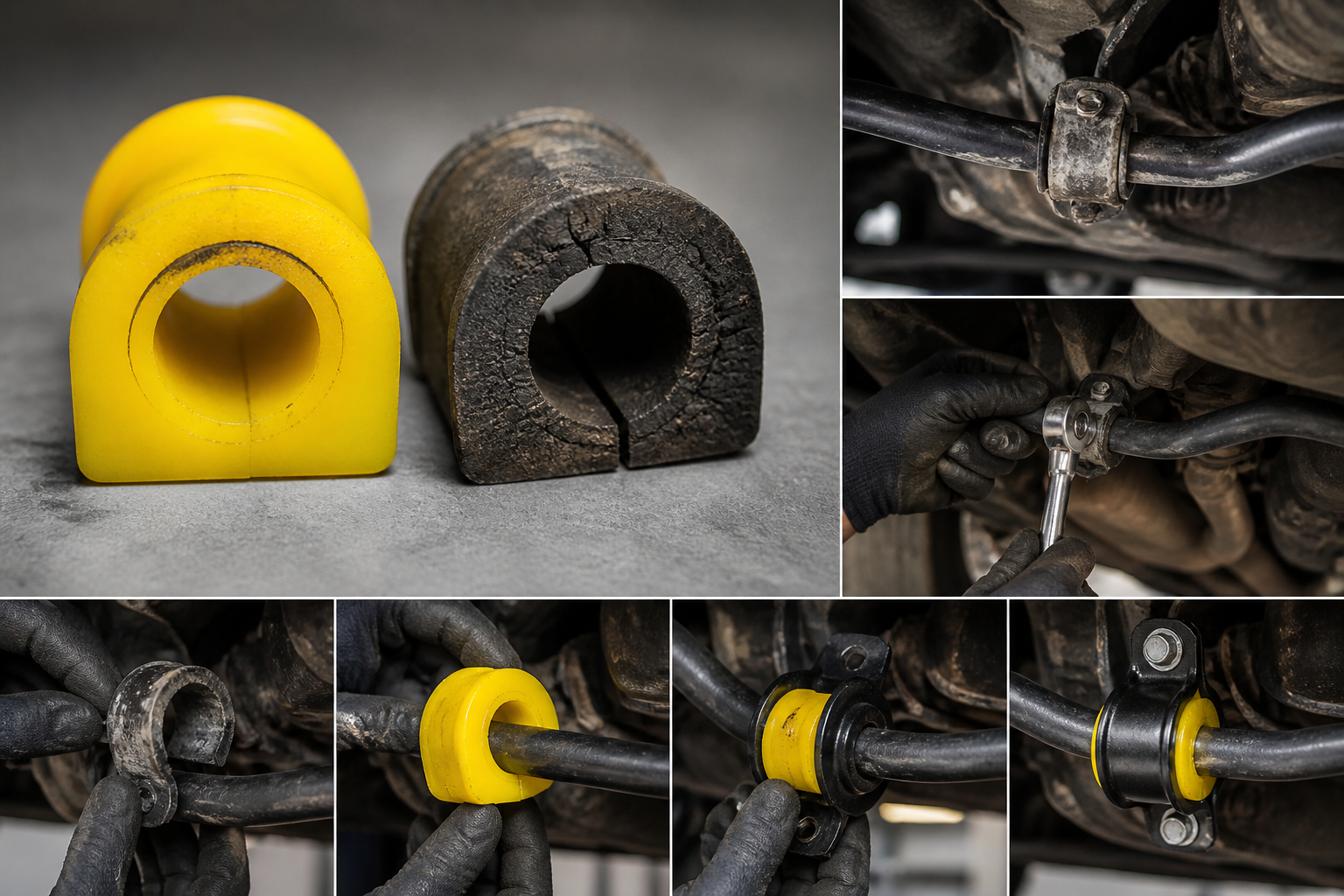
Step 1: Prep and Access
Park the car on level ground and set the parking brake. Lift the car and support it on jack stands. On most passenger cars, you can reach the mounting brackets from underneath without removing the wheel. If there isn't enough room, take the wheel off.
Step 2: Removing the Bracket
Undo the mounting bracket bolts — usually 2 bolts per side. If the bolts are seized, spray them with WD-40 and wait 15 minutes before trying again.
Step 3: Removing the Worn Bushing
Lower the bracket and slide the old bushing off the bar. Most rubber bushings have a lengthwise slit and come off by hand. If one is stuck, cut along the slit with a knife and pull it free.
Step 4: Prepping the Mounting Surface and Installing the New Bushing
Clean the rust and grime off the bar. Apply grease to the inner surface of the new bushing and to the bar itself — this matters even more for polyurethane bushings, to prevent squeaking after installation. Slide the new bushing onto the bar straight and evenly seated, without letting it sit at an angle.
Step 5: Torquing the Bolts Under Load
Put the bracket back in place and start the bolts by hand. Lower the car back onto the ground — only then tighten the mounting bolts fully. Torquing them while the suspension is still hanging free cuts the bushing's service life roughly in half, because the part stays permanently twisted under load.
After the job, get a wheel alignment done: if the car pulled to one side or the tires wore unevenly before the replacement, the geometry needs to be restored. For a step-by-step guide to replacing other suspension bushings, see How to Replace Bushings.
Differences by Make and Model
The process of replacing front sway bar bushings is basically the same across most cars, but there are a few make-specific quirks worth knowing.
Volkswagen Golf and Passat
On the Golf, the sway bar bracket is often held by a single 13 mm bolt instead of two. Access from underneath is easy, and you don't need to remove the wheel. Rubber bushings on the Golf wear out relatively fast because of the stiff sway bar and frequent city driving — we recommend switching to polyurethane the first time you replace them.
Lada, Daewoo Lanos, and Other Budget Cars
On cars with a simpler suspension design, access to the brackets is especially easy — the job takes just 20–30 minutes. Rubber bushings wear out after 30,000–50,000 km on rough roads, so switching to polyurethane sway bar bushings pays off especially well given the harsh operating conditions.
Vehicles with Subframes and Crossovers
On vehicles with a complex subframe, you sometimes need to drop the subframe 5–10 cm to reach the rear brackets. In most cases, though, replacing the front sway bar bushings doesn't require this at all.
Rubber or Polyurethane: Choosing the Bushing Material
Choosing a material comes down to a trade-off between price and service life.
Rubber bushings wear out after 30,000–60,000 km depending on conditions. On Ukrainian roads, winter weather, de-icing chemicals, and temperature swings all speed up degradation. Rubber parts are cheaper upfront, but need replacing more often.
PolyPro polyurethane bushings last 3–5 times longer. They resist de-icing chemicals, oils, and temperatures from −40°C to +70°C (−40°F to 158°F). They're a bit firmer, which sharpens steering response and improves stability in corners. They come with a 12-month warranty with no mileage limit.
There's one condition for installing polyurethane: you must grease the inner surface and the bar. Without grease, you'll get squeaking — not because of the material itself, but because of the dry contact. For more on what causes squeaking and how to prevent it, see Why Do Sway Bar Bushings Squeak?
For a car with over 80,000 km on the odometer, polyurethane pays for itself from the very first replacement — you won't be back doing this job again 40,000 km later.
Отримати консультацію по підбору деталей:
Get a consultation on choosing the right parts:
Получить консультацию по подбору деталей:
VIBER

TELEGRAM

Cost: Doing It Yourself vs. Paying a Shop
The cost depends on whether you do the job yourself or take it to a shop.
DIY — you only pay for the parts. Rubber bushings start from 80 UAH each; PolyPro polyurethane bushings cost about the same but deliver a far longer service life. It works out cheapest if you have access to an inspection pit or a lift and a basic wrench set.
At a shop — labor starts from 500 UAH for a full kit on both sides. Getting the job done in Kyiv or another major city costs more than in smaller towns. If you get a wheel alignment at the same time, add another 400–800 UAH. Since the job itself is straightforward, shop prices are usually lower than for replacing control arm bushings.
Doing it yourself is realistic even without prior experience: replacing sway bar bushings doesn't require special equipment and is simpler than most other suspension jobs. Mechanics who value long-term durability over a one-time discount typically recommend PolyPro parts for this exact reason.
Where to Buy Sway Bar Bushings
PolyPro polyurethane sway bar bushings are available for most vehicle makes and models: passenger cars, vans, and commercial vehicles. We can match parts by make and model, or make a custom size to match a sample or a part number. Parts start from 80 UAH; a shop replacement starts from 500 UAH for the full kit.
Browse the catalog at kapot.in.ua or call us: (050) 21-35-163, (067) 21-35-163 or message us on Viber.
